

A beautifully written, haunting tale of motherhood, guilt, myth and redemption set on the rugged coast of Caithness at Scotland’s furthest edge.
When Maggie Thame, a childless forty-something from Oxford, relocates to a remote village at Scotland’s most northern edge, it’s clear she’s running away. But to the villagers the question remains, from what?
Pursuing her career as a freelance cartographer, she lives in self-imposed isolation, seeking refuge in the harsh beauty of her surroundings. This is disturbed when she falls into an uneasy friendship with Trothan Gilbertson, a strange, other-worldly local nine-year old. Like Maggie, it’s unclear where Trothan really comes from, and what secrets might be lurking in his past. The lives of both become intertwined, with violent consequences that will change the destinies of woman and boy forever, forcing Maggie to confront the tragic events that first drew her to this isolated place.
In this, her debut novel, award-winning writer Linda Cracknell explores themes of motherhood, guilt, myth and the elemental forces of nature in a lyrical, taut and haunting account of damaged lives seeking redemption.
‘…a haunting tale that, like the landscape in which it’s set, is perched on the cusp of the super natural without ever quite toppling in.’
The Herald
‘An astonishingly beautiful novel with passages of exquisite nature writing, light-touch description and a well-paced narrative which moves around the human psyche like a restless wind.’
Northwords Now
‘This is a stark, atmospheric novel, with a strong sense of place: the wheeling sea birds, the endless ocean, and the drama of the big sky are all powerfully evoked, as is the sense of a small community where everyone knows everyone else’s secrets.’
The Independent
‘The past and memory form the fulcrum in what is the first full length novel by one of Scotland’s most exciting new talents. This atmospheric and finely crafted work certainly marks Cracknell as one to watch in 2014.’
Waterstones Edinburgh
‘Every so often… The universe gifts you a book the reading of which becomes more important than anythign else you could be doing at that moment… a reality that snares you so completely that for a few hours, t’s the rest of the world that is shelved. Such a book is Call fo the Undertow.’
The Book Bag
‘Call of the Undertow is instead dominated by the beautiful but rugged landscape and a haunting sense of mystery.’
Annabel’s House of Books
‘…one of the most enchanting and magical novels of the year.’
Scots Whay Hae!
‘Cracknell managed to paint a picture of the coast so well that I found myself yearning for the sea. The setting was quite beautifully described in places. Matched with some harsh realities of life (which are true no matter where in the world that you are), Call of the Undertow is a quaint, but grounded, read that deals with loneliness and redemption.’
Subtle Melodrama
‘The evocation of Scotland’s sublime landscape (in the Edmund Burkean sense) is Cracknell’s main focus and the locus of its intensity… Call of the Undertow sustains its marvellous depth of feeling. The cartographic and/or perambulating trope, and the sublime evoked that is in turns beautiful and terrifying, are very finely wrought. Call of the Undertow‘s engagement with hearts as well as minds responds to the question posed poignantly in Kei Miller’s The Cartographer Tries to Map a Way to Zion; “how does one map a place that is not quite a place?’
DURA
‘mysterious, deeply touching and makes enchantment feel very close to daily life’
Sara Maitland
‘… seductively pulls the reader into the deeper more dangerous currents of the human heart. Emotions ebb and flow along with the tide, in language clear and crisp as sea air.’
Cynthia Rogerson
‘Linda Cracknell’s Caithness rises up off the page and takes form around us… Its light and skies, rocky shores and wheeling, screaming gulls, huddled villages and craggy beaches, its grave, austere beauty… Reading this book is like being there.’
Kirsty Gunn
‘At the same time beautiful and haunting, it conveys a remarkably strong sense of place and tradition, that rugged remote landscape (and coastline) of the North of Scotland.’
Angie Crawford, Scottish Buying Manager at Waterstones
‘Linda Cracknell’s Call Of the Undertow is one of the most haunting and evocative novels I’ve read in a long time. Her characters are compelling and completely believable, while her sensitive, lyrical depiction of the natural (and supernatural) world shows her to be among Scotland’s finest contemporary writers.’
Andrew Crumey
‘…quiet, thoughtful read. The novel mirrors the moody landscape so well described by Linda Cracknell.’
Luxury Reading blog
‘An eerie and evocative debut novel: read it and be transported.’
Book Hugger
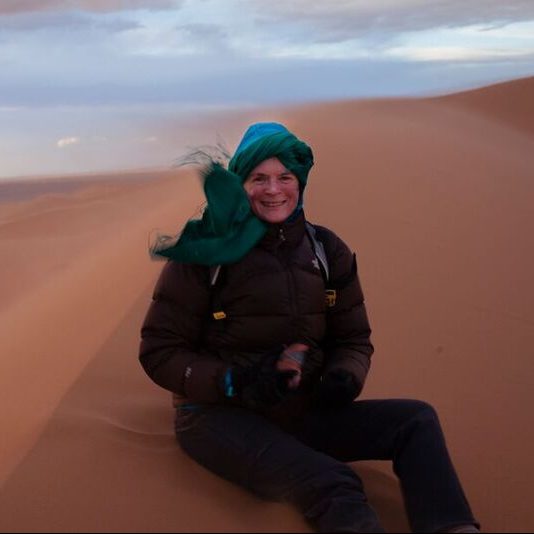 | Linda CracknellLinda Cracknell is a writer of prose and radio drama. Her two collections of short fiction – Life Drawing (NWP, 2000) and The Searching Glance (Salt, 2008) – both featured on award lists. Among her plays for BBC Radio 4 is The Lamp, broadcast in December 2011, which brought together a visiting Kenyan librarian and Scotland’s first public lending library, now preserved as a museum, for an exploration of the liberating power of books and reading. She is the editor of a non-fiction anthology on the wild places of Britain and Ireland, A Wilder Vein (Two Ravens Press, 2009). Her first novel Call of the Undertow (Freight Books, 2013) is a haunting tale of motherhood, guilt, myth and redemption set on the rugged coast of Caithness at Scotland’s furthest edge. A collection of non-fiction essays on the subject of walking, Doubling Back: Ten Paths Trodden in Memory (Freight Books, 2014) was the culmination of a lengthy project initiated when she was the recipient of a Creative Scotland award in 2007. Linda has tutored many writing courses and workshops including for the Arvon Foundation, and has facilitated creative writing as part of a number of major school projects, from learning about constellations to devising interpretation for a long-distance footpath. She has been |
