
Cultured Llama 2015
ISBN 978-0-9926485-7-2
An MA in American Literature, an editor and educator of all aspects of writing, widely published in a huge array of journals, magazines, and with three other poetry collections to his name, poet Julian Colton has every reason to rest on his laurels. Fortunately for us, it seems he has been restless these past few years, during which time he has somehow summoned into existence his magnificent fourth collection Cold Light of Morning.
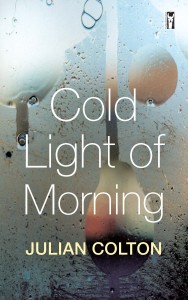
I use the word “summoned” only because, as with all important works of literature, it is difficult to imagine this collection actually being written. First and foremost this book is a work of art. The sleek, intriguing cover – featuring photography by the poet’s daughter, Rozee Colton (a talented artist in her own right) perfectly captures the essence of these poems taken as a whole – honest reflection on the evening’s musings in the cold light of morning. The cover itself is expertly suggestive of the poet’s special style of gazing outward. It has us peering from a safe place, through a wet mist of breath on a cold pane of glass into the vague warmth of another human form, determined to focus on the humanity of its subject. What a perfect tribute to his poetry it is.
Individually, the poems which make up this collection are windows with unparalleled views of their subjects – that they happen to be built into a pristine fortress is no accident. Whether misty or clear, closed or open, these windows offer exceptional views of the streets, hospitals, gardens and graveyards which form the perfectly-lit landscapes of the poet’s memories.
And what landscapes they are. Taken as a whole these poems offer the reader an incomparable vista – taking the all who turn the books pages on a unique journey which starts in Manchester and soars through Scotland with apparently effortless grace.
Taken as a whole – an easy thing to say, perhaps more difficult to do, considering there are over sixty poems in this collection. You might think so – but Julian makes it easy for his readers, with meticulously selected and structured poems which flow from theme to theme with unparalleled style.
Take any three lines from any one of the poems from this collection and you have a fresh lesson in how to put into practice the age-old adage “Show not tell” – a phrase Colton perfectly encapsulates in his poem of the same name, and exemplifies in this collection. Not only does he “capture the abstract” – he holds it out for us to name as our own, despite the deeply personal nature of his subjects. And in doing so, he has made his craft into art.
The closing three lines of “Winter Walk”, for example – even taken out of the more complex context of the poem as a whole, make fresh, exquisite poetry of familiar local footpaths.
“Turn and walk back from winter bridal whiteness.
Snow and ice will keep its own counsel
As I, star-flowing, glass-eyed river, shall too.”
But the landscapes of Julian’s describing – though beautiful and literal at times, are revealed as complex and various fabrics throughout the course of the book. Motifs of motherhood and fatherhood form the warp and weft of this expertly personal tapestry, interspersed with filaments of loss and desire, knotted with unbreakable bonds of love and blood. With the skill of an accomplished Borders weaver, Julian interweaves the rough strands of life and death together with a strength, skill and delicacy which leaves the reader of this book closing it with a distinct feeling of having read not so much a collection, but a novel of no small importance.
And this is an enormously significant book – not just for Colton, who has finally emerged as an important British poet at the peak of his powers through its pages, but also for the Borders as a whole – a place often celebrated from within, but never so intimately, bitterly and tenderly as here, through the eyes of a local who was once a stranger among its hills and brooks – whose poems document the lives which flicker among its landmarks with startling grace and clarity – not only as a spellbound observer, but patiently, reverently, and completely in the cold light of morning.
Sara Clark, The Eildon Tree 26
 | Julian ColtonJulian Colton has had three collections of poetry published including Everyman Street (Smokestack Publishing, 2009) which was in the Hand + Star review websites’ top 5 books for 5 weeks over Christmas and New Year 2009/10. In 2008/9 he was CREATE Writer in Residence for Dumfries and Galloway. He continues to teach poetry, most recently as part of the Natural Identity project for the Tolbooth Gallery in Stirling, the Artists Rooms Robert Mapplethorpe exhibition in Galashiels, Aye Write in Glasgow and the Luminate Festival. He also facilitated a poetry writing workshop at the Borders Book Festival in Melrose in June 2012. He co edits The Eildon Tree magazine, writing many articles and reviews. He has also had up to 100 poems in magazines and anthologies including Stand, the Rialto, Cencrastus, Northwords Now, New Welsh Review, Scottish PEN Website, Gutter, London Magazine, My Mum’s a Punk, Orbis, Poetry Scotland etc. Although born in Manchester, he has been resident in the Borders for twenty years. He read at the Abbotsford Poetry Showcase in November 2013 and his fourth collection of poetry Cold Light of Morning is due to appear in 2015. |