
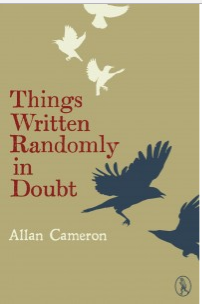
A work in three parts, Things Written Randomly in Doubt starts with aphorisms in “How Not to Be a Ruminant”, shifts to essays in “Weights and Counterweights”, and concludes with poetry in “By the Metre”. Some arguments appear in more than one section, and include nationalism, class, free will, religion, literature and the arts, but the theme of human relationships runs through the entire book, and is most closely examined with reference to Martin Buber’s ideas in a long essay entitled “Cats and Dogs, and Other Things We Cannot Understand”.
“[Things Written Randomly in Doubt] has all of [Cameron’s] customary boldness of thought and range of interest, and is properly unafraid to raise the most fundamental issues. … This book is gratifyingly lucid and has many wise things to say.” – Terry Eagleton
“… there is in Cameron’s work a lingering spirituality, a faith that something soulful and significant is present in the everyday, in the ordinary ‘heroism of mortals’ he writes of. On occasion this takes the form of scepticism about science’s claim to be able to quantify and explain all experience. Like the philosopher John Gray, he is dubious about ‘progress’, political, economic, and scientific. … if Scottish literature has a true outsider, it is not Irvine Welsh: it’s Allan Cameron.” – Scottish Review of Books
“‘The aphorism is a very limited,’ writes Cameron, which is ironic as the first 80 pages of this book consist of nothing else. The rest is comprised of a series of essays, in which he examines such topics as the fluid and debatable concept of national identity – beginning with the Franks, who had no land truly to call their own – and the concepts underpinning various nationalist movements down the centuries. The same Allan Cameron who can turn musings on dog owners into an epic meditation on how we see ourselves in relation to others also relates his experiences of class consciousness in Britain and Italy, examines the concept of friendship and chooses to Evelyn Waugh and AL Kennedy as examples of the ways authors write about themselves. Up-to-date enough to include references to Project Fear, this stimulating book works its way up to an atheistic defence of religion and the biggie itself: free will.” The Herald
ISBN: 978-1-908251-27-5
Published by Luath Press Limited
 | Allan CameronBorn in Watford in 1952, Allan Cameron was brought up in Nigeria and Bangladesh. Having left school at sixteen, he worked at sea for a few years before moving to Italy in his late teens, where he had a variety of jobs. At the age of 31 he went to university and, after graduating, worked in the same department he had studied in. In 1992 he moved to Scotland and worked as a translator (and has now translated some 25 books). His first novel The Golden Menagerie was published by Luath Press in 2004, and this was followed up in 2005 by The Berlusconi Bonus (also Luath Press), which was translated into Italian and published by Azimut in Rome. Since then Vagabond Voices has republished The Berlusconi Bonus in addition to several others: In Praise of the Garrulous, among the publisher’s series of “Rants”, a selection of poetry entitled Presbyopia, and two collections of short stories, Can the Gods Cry? and On the Heroism of Mortals. His collection of aphorisms and essays, Things Written Randomly in Doubt, has just been published (19 May 2014). It argues that only the class distinction is a necessary division within humanity, but does not argue it from an economic point of view. Inequality commodifies and degrades our human relationships, which should be based on dialogue (the acceptance of the other’s autonomy). Other distinctions should not be dangerous (though the powerful often deflect class issues by aggravating them) and can enhance each other. One essay is a defence of religion and another two examine how nationalism is evolving and becoming to the aid of internationalism rather than subverting it. Arguments and counterarguments abound, and the primary intention is to provoke further debate. |
